How to Make Money with Photography: My $500,000 Case Study
If you are wondering how to make money with photography in today’s saturated market, this week I reached the almost magical half a million dollars in lifetime earnings! However, I need to start with a dose of brutal honesty.
But—and it is a big but, I started 18 years ago when online stock photography was in its infancy and competition was low. Replicating that exact path today is highly unlikely, and anyone promising you instant riches or a “magic bullet” is likely trying to scam you. However, by looking at my spreadsheet tracking every agency and the majority of sales since 2008, a very clear path forward emerges. While traditional microstock payouts are steadily shrinking, my data shows that a combination of active uploading to stock agencies of images that tell a story and, in parallel, pivoting to fine art prints and products is a feasible way to continue to generate a real income today. I don’t have a secret formula to sell you, but I do have 18 years of hard data to show you exactly how this industry is shifting—and where the realistic opportunities actually are.
As if to prove the point that a transition away from stock photography is the way forward (at least for me), the earnings that pushed me to that magical total from the earnings I reported at the end of June were profits of $75 on a print on Fine Art America and $236 for a print on Pictorem. As if to reinforce that shift, the one-time leader of the Stock Photography world, Shutterstock, has earned a total of just $52 in the first 12 days of July.
How my income from photography grew
Get ready for some facts to back up this flashy start. This cumulative earnings graph sets the scene:
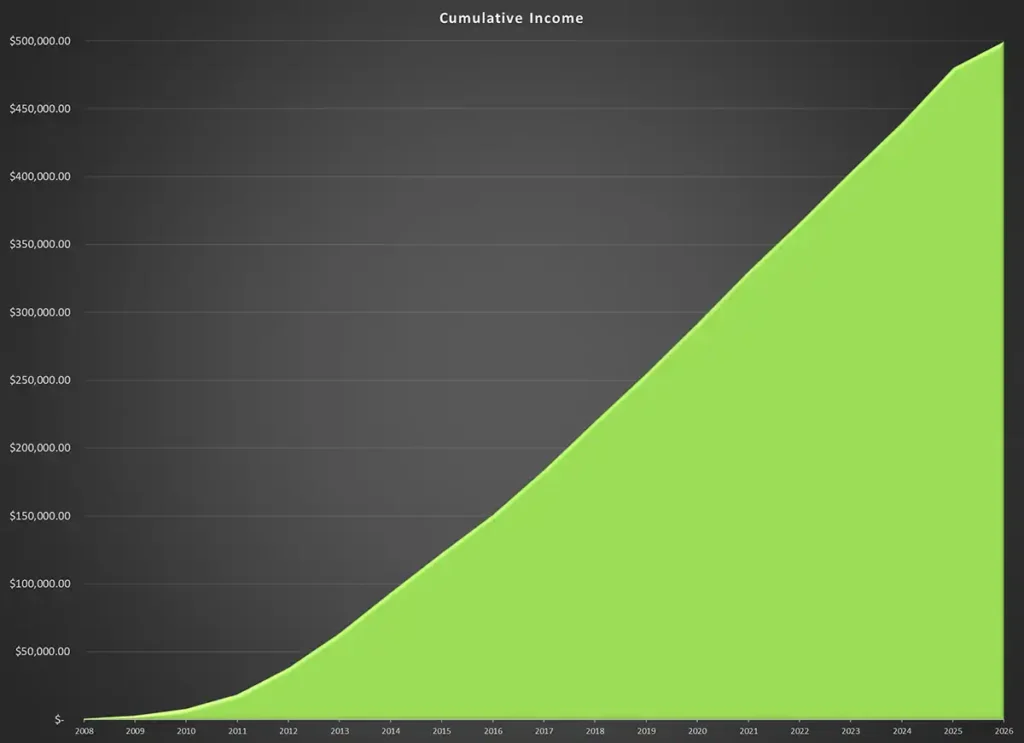
It is interesting that after the relatively flat start through 2012, it has almost been an increasing curve for the rest of the series. 2026 appears to show a flattening off, but that is simply because that represents six months rather than a full year.
The effects of inflation on earnings
But wait, you say, weren’t the earnings at the start of the chart worth more in terms of purchasing power? I’m not sure how many people are asking that, but I did, and my AI friend gave me the answer. This is the year-by-year earnings chart in 2026 dollars.
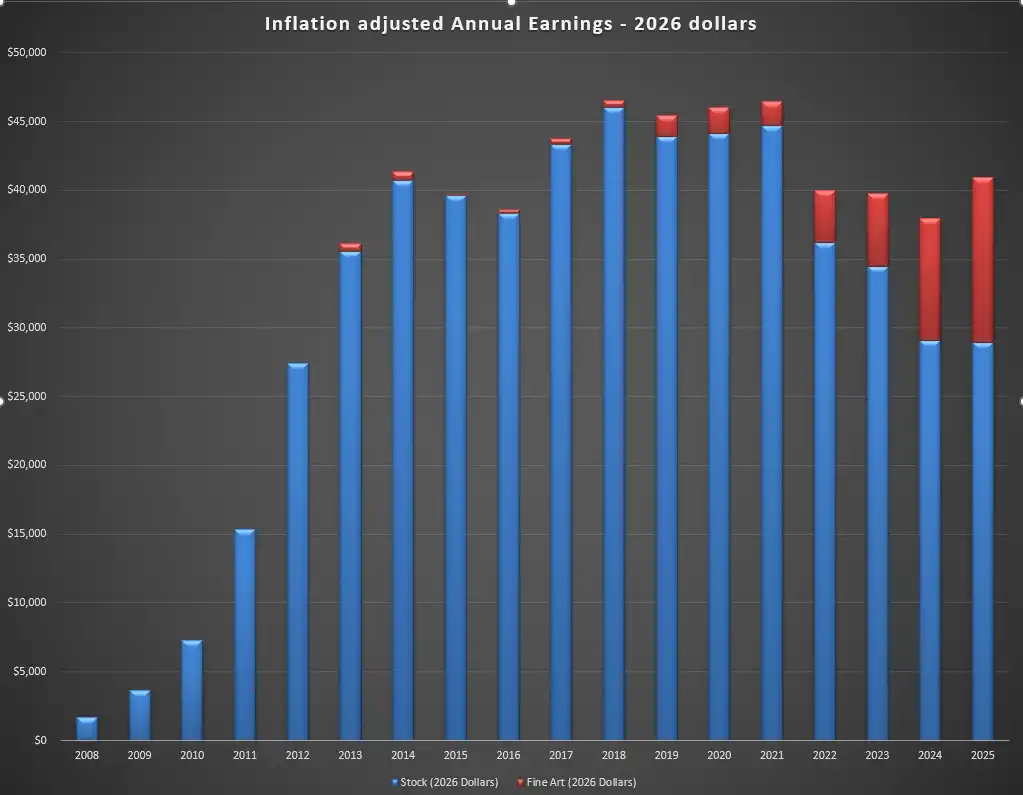
This chart shows several things. In 2026 dollars, the peak year for stock photography was actually 2018 for me. The next years came close, but since 2021, the earnings have started to decline significantly. The red bars represent my earnings (profit) from selling fine art prints, originally on Fine Art America and since 2022 from an expanding range of outlets. Overall, this shows that if I had just stuck with stock photography, I would have been facing a year-by-year decline but the shift into fine art related work has at least given my earnings a new lease of life.
I know almost everyone in the business calculates the earnings in current dollars (ie ignoring inflation). For comparison, here is what I would normally show – this is the chart that simply shows the actual cash earnings each year – a pretty different picture.
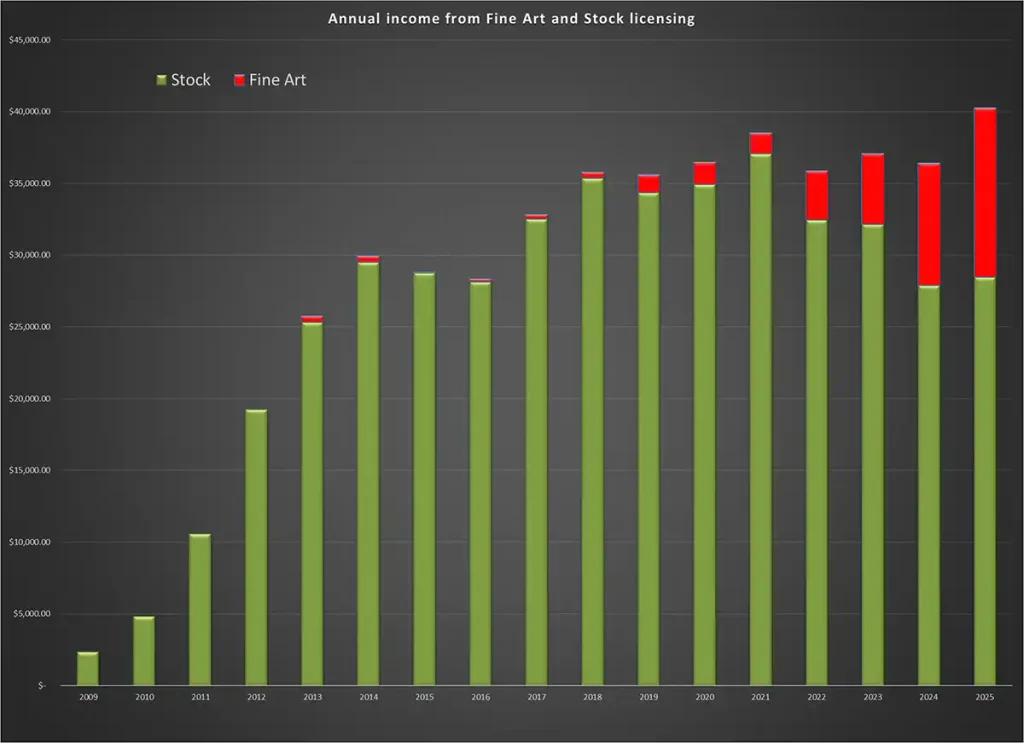
Perhaps I prefer that – 2025 was my best year ever!
How have stock agencies changed over the years?
We all know the top line feeling. Shutterstock has fallen from grace and Adobe Stock is the new leader of the pack. But what is shown in the details?
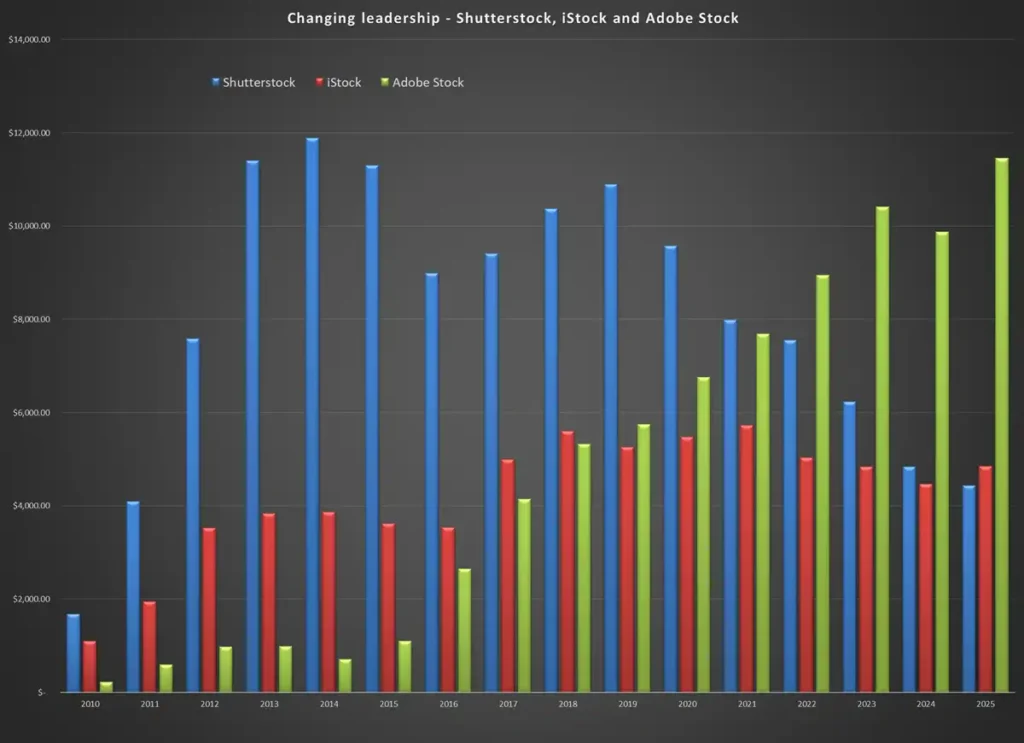
I counted the early days with Fotolia in the Adobe Stock totals, but you can see how they have really taken off since Adobe bought out that agency in around 2016. iStock has been relatively flat over the years, and Shutterstock has done what we all see Shutterstock doing!
Which agencies have contributed the most to my earnings over the years?
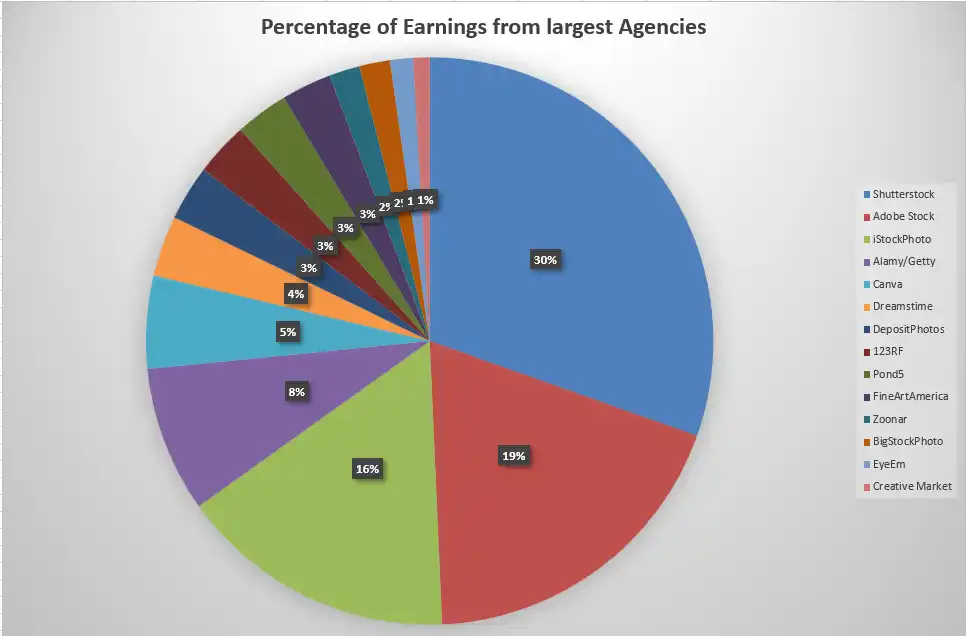
I decided on a pie chart to try to show what percentage of my overall earnings came from each agency. This is over almost 18 years now, but over that time frame, Shutterstock has definitely been the best agency for me in terms of total earnings. But what is equally interesting is how all the smaller agencies have together contributed around 35% of the total. Each one is relatively small, but collectively they make a difference.
Good news (I guess)
I’ve kept details of the different types of downloads from Shutterstock over all these years, which allows me to calculate the $ per download figures. In effect, I divide the income from photos (removing video income) by the number of downloads. You would have expected this to be worse now, but actually it didn’t change all that much:
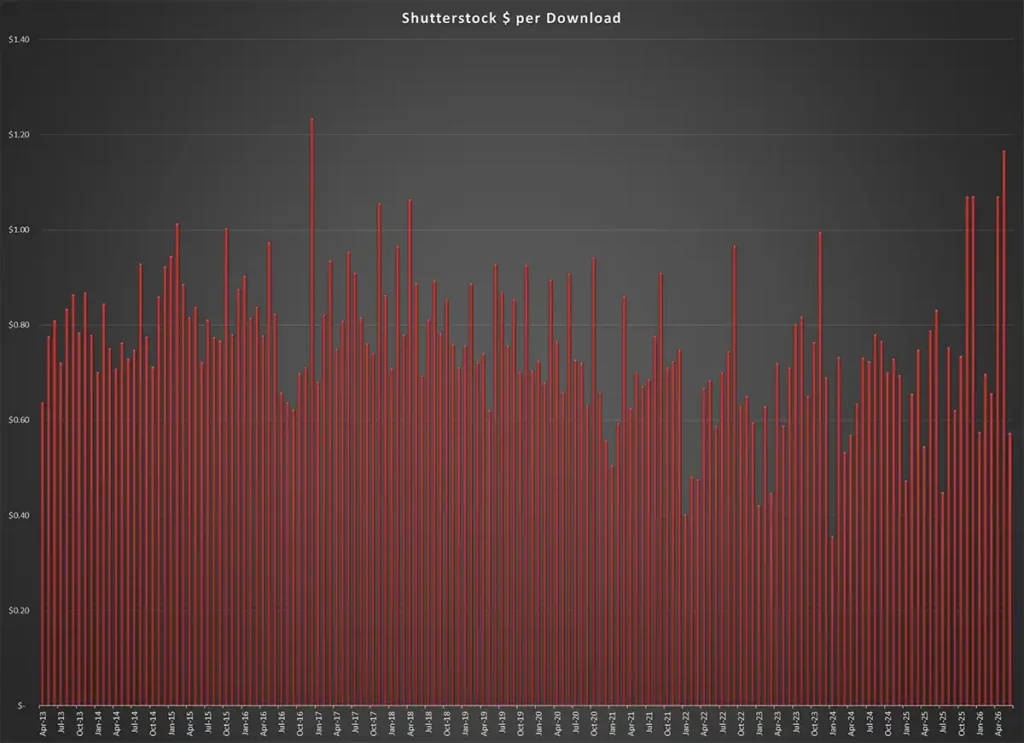
There was a bad period earlier in this decade, but there have been some good months since. I always say that a good month on Shutterstock is heavily dependent on the number of higher priced downloads and I think this is clearly showing how much more variable it has become. In the early days, the $0.38 subscription downloads gave a certain stability to the income. Now, it is all over the place. Remember this is not inflation adjusted and so in reality, in real buying power, it is much worse now.
What does all this mean?
I have continued to add files month by month over the years. I’m now at almost 25000 assets in the largest agencies. And yet with that effort, my income from stock is clearly dropping and there is no reason that I can see why that will change.
I continue to travel and continue to take photographs when I travel. I no longer bother with product type shots – too easy for AI to create those. I never bothered with people shots (ditto). But I think I would take photos when I travel regardless of whether I was still doing stock photography. I actually enjoy doing it!
I am doing more and more photography aimed at the fine art market. I am trying to make contact with more of the companies and consultants who source artwork for corporate offices and healthcare facilities. And I need more fine art type photos to expand my portfolio to cover more locations as location specific imagery is often sought by a company looking for artwork for their office. Show visitors the best of the local area, in effect.
I would really like a way to be able to really judge whether an image will be a good prospect for print sales. I was talking to a photographer gallery owner yesterday (he does portraits mainly) and he said he was always amazed when someone comes in with a file of an image for printing. He does check that they have the license to print it (not sure every print shop does that!), but they have often bought a digital download on Etsy for $10 and then they pay him $300 to print and perhaps frame it. I don’t directly sell digital downloads, but of course someone could go to a stock agency and pay for a download of one of my best prints. Yes, I get the download fee, and I am sure many others license it for purely online use, but it does seem like I throw money away.
I do, however, try to make my best work appear high in the image search engine results by careful use of metadata, by writing illustrated articles about my work and by building direct control of the relationship with the customer via my Etsy store in particular. If I can make the visibility and purchase of my prints as simple as possible, I might not lose much via stock agency downloads for prints.
For now, my fine art related work is definitely helping bridge the gap between my usual income and the falling stock photo income. Just how long I can maintain that is anyone’s guess.
I hope you found this interesting – a more instructive post than a simple, “I did it – I got to half a million!”


18 years or not, the achievement is still incredible!
Thanks Elijah – it is quite an achievement!
Good to hear that you are still uploading. My sales in stock currently are mostly landscape and buildings. Products, concepts etc do not sell anymore.
Hi Alessandra – yes, I am just in the middle of uploading another 500 travel images! Quite a lot of work, but at least something is happening with the photos I have taken. I rarely upload anything else – not worth it these days!
Thank you for sharing this, Steven! Your work and experience are truly inspiring. Have you considered creating a photography community on Skool? I’m sure many people would benefit from your insights, and I’d gladly be among the first to join. 🙂
Perhaps I am showing my age, but I have never heard of Skool! I should investigate. And thanks for your kind comments!
Congratulations on the milestone and thanks for the article. Given nearly half of Adobe Stock’s collection is genAI, I am surprised that my sales have held up. I think your experience shows that even in the age of AI, there’s still a market for quality images of the real world, even though the economics have changed dramatically
Yes, it is pleasing to see that Adobe seems to be maintaining its sales (at least for us). I hope it continues. I think it will be some time before real places are generated by AI.
Hi Steve,
Thanks for sharing your monthly stock photography earnings. I have a question about Canva earnings.
I’ve been a Canva Contributor for a while, although my portfolio is still fairly small. Recently, I uploaded more photos, and I’ve started seeing customers use my assets more often.
On my Canva Dashboard, I currently have around 300 Applied and 110 Exports. However, when I go to Creators > Earnings and select This Month, Canva tells me to wait until after the 15th of the month before the earnings are available.
Since this is the first month I’ve reached about 110 exports, I have no idea what kind of earnings to expect. Based on your experience, do you have a rough estimate of what that might translate to?
Also, do you only upload photos to Canva, or do you also contribute other types of digital assets such as videos, illustrations, graphics, or design elements?
Thank you in advance for any insights!
Regards,
Liam N
I have only submitted photos, but Canva has been a real disappointment to me. I used to earn several hundred dollars a month but it has dropped month by month as if it is driven by some algorith. I wrote about it here: https://backyardsilver.com/monthly-earnings-from-online-photography-february-2026/ I have never actually looked at the usage – I just look at what they pay me each month, and so I really don’t have any idea about what you might expect in terms of earnings. It won’t be long before we get those earnings now. Sorry this isn’t more useful!
It helps a lot, thank you!